Introduction
Software development requires skilled professionals, advanced technologies, and efficient project management. However, building and maintaining a complete in-house development team can become expensive due to recruitment costs, employee benefits, infrastructure expenses, and long hiring cycles.
IT staff augmentation provides businesses with a flexible approach to accessing skilled developers and technology professionals without the financial burden of traditional hiring. Companies can scale their teams based on project requirements while maintaining better control over development costs.
What Is IT Staff Augmentation?
IT staff augmentation is a workforce strategy where businesses hire external technology professionals to work alongside their internal teams. These professionals provide specialized skills for a specific project, technology requirement, or business period.
Unlike outsourcing, where an external company manages the entire project, staff augmentation allows businesses to maintain complete control over development processes while adding experienced resources.
Why Software Development Costs Increase
- High recruitment and onboarding expenses.
- Long hiring timelines.
- Employee salaries and benefits.
- Infrastructure and software costs.
- Training expenses.
- Difficulty finding specialized skills.
- Maintaining resources during low workloads.
- Project delays caused by skill shortages.
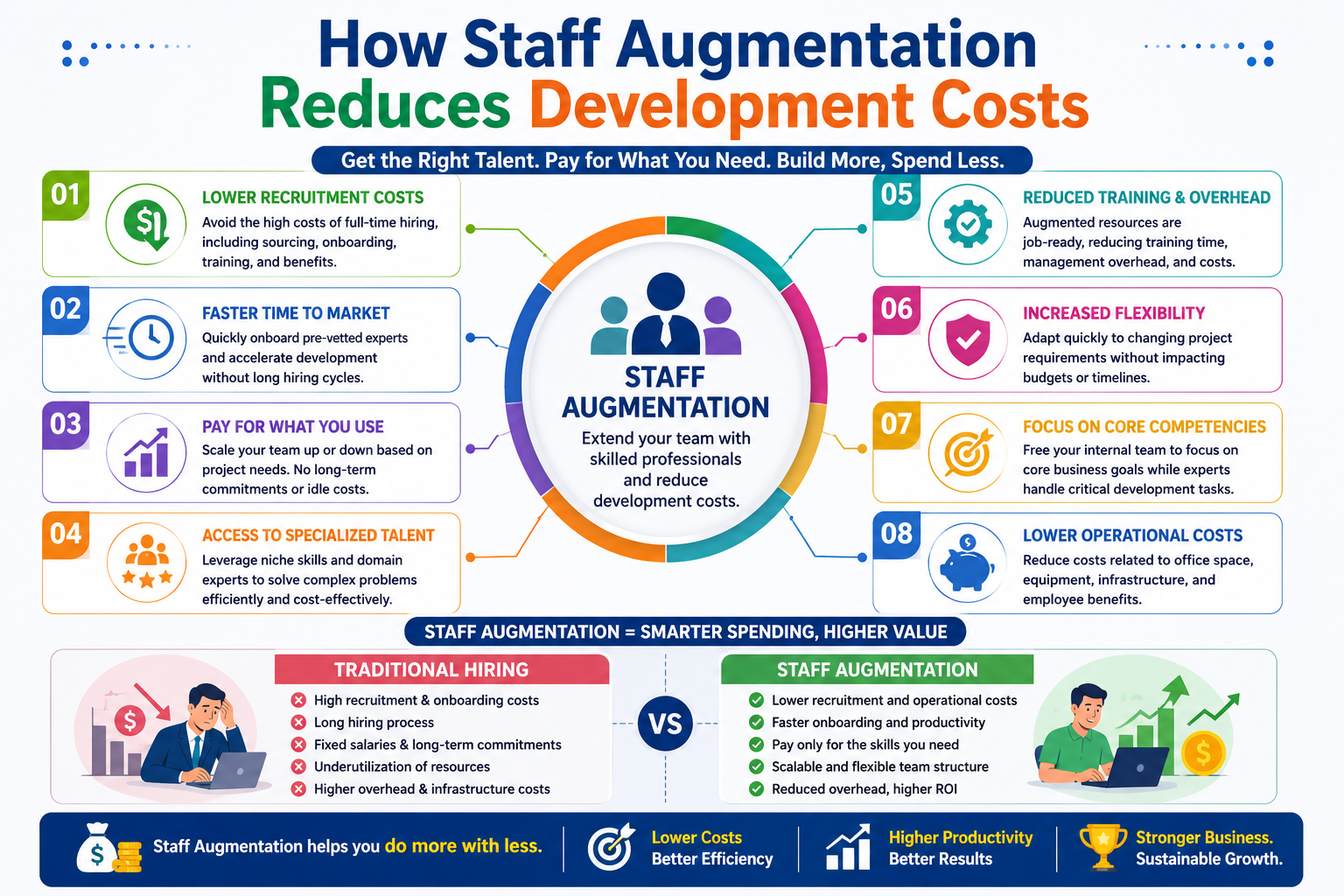
How Staff Augmentation Reduces Development Costs
1. Reduces Recruitment Expenses
Hiring full-time developers requires investment in job advertising, recruiter fees, interviews, onboarding, and employee benefits. Staff augmentation eliminates many of these expenses by providing ready-to-work professionals.
2. Faster Access to Skilled Developers
Finding specialized developers can take months through traditional hiring methods. Staff augmentation provides immediate access to experienced professionals, helping companies start projects faster and reduce delays.
3. Flexible Team Scaling
Businesses can increase or decrease team size based on project requirements. This prevents companies from paying for unnecessary resources after project completion.
4. Lower Operational Costs
Companies save money on office infrastructure, hardware, employee benefits, training programs, and other expenses associated with maintaining a large permanent workforce.
5. Access to Global Talent
Staff augmentation allows businesses to hire skilled professionals from global talent markets, often providing access to competitive pricing without compromising technical expertise.
6. Reduces Project Delays
Skill shortages can slow down development. By adding experienced developers quickly, companies improve productivity and complete projects within planned timelines.
7. Minimizes Hiring Risks
Permanent hiring decisions involve long-term commitments. Staff augmentation allows businesses to evaluate professionals through project collaboration before making permanent hiring decisions.
Cost Benefits of Staff Augmentation
- Lower recruitment costs.
- Reduced employee benefit expenses.
- No long-term salary commitments.
- Lower infrastructure investment.
- Faster project execution.
- Better resource utilization.
- Reduced training costs.
- Improved budget flexibility.
- Access to specialized expertise.
- Reduced operational risks.
Staff Augmentation vs Traditional Hiring Costs
- Recruitment: Staff Augmentation - Lower cost | Traditional Hiring - Higher cost
- Hiring Speed: Staff Augmentation - Faster | Traditional Hiring - Slower
- Flexibility: Staff Augmentation - High | Traditional Hiring - Limited
- Employee Benefits: Staff Augmentation - Reduced responsibility | Traditional Hiring - Company responsibility
- Scaling: Staff Augmentation - Easy | Traditional Hiring - Difficult
- Specialized Skills: Staff Augmentation - Immediate access | Traditional Hiring - Requires searching
When Should Businesses Use Staff Augmentation?
Staff augmentation is especially useful for businesses that need additional technical expertise, faster development, or temporary workforce expansion without increasing permanent operational costs.
- Software product development.
- Startup technology projects.
- Enterprise application development.
- Cloud migration.
- AI and automation projects.
- Mobile application development.
- Digital transformation initiatives.
- Short-term skill requirements.
Best Practices to Maximize Cost Savings
- Clearly define project requirements.
- Select developers with relevant expertise.
- Set measurable project goals.
- Use effective collaboration tools.
- Maintain regular communication.
- Track productivity and performance.
- Choose the right staffing partner.
- Plan resource requirements in advance.
Conclusion
IT staff augmentation provides a cost-effective way for businesses to build powerful development teams without the expenses and risks associated with traditional hiring. By accessing skilled professionals, scaling resources efficiently, and reducing operational costs, organizations can accelerate software development while maintaining budget control.