Introduction
The recruitment landscape is evolving faster than ever. Advancements in technology, changing workforce expectations, and increasing competition for skilled professionals have transformed how organizations attract and hire talent. Employers who stay informed about the latest recruitment trends are better positioned to build high-performing teams and maintain a competitive edge.
From AI-powered recruitment tools to skills-based hiring and remote workforce strategies, businesses are embracing innovative approaches to improve hiring efficiency and candidate experience.
Why Recruitment Trends Matter
Understanding current recruitment trends enables employers to reduce hiring time, improve candidate quality, strengthen employer branding, and adapt to changing workforce expectations. Companies that modernize their hiring strategies are more likely to attract top talent and improve employee retention.
Top Recruitment Trends in 2026
1. AI-Powered Recruitment
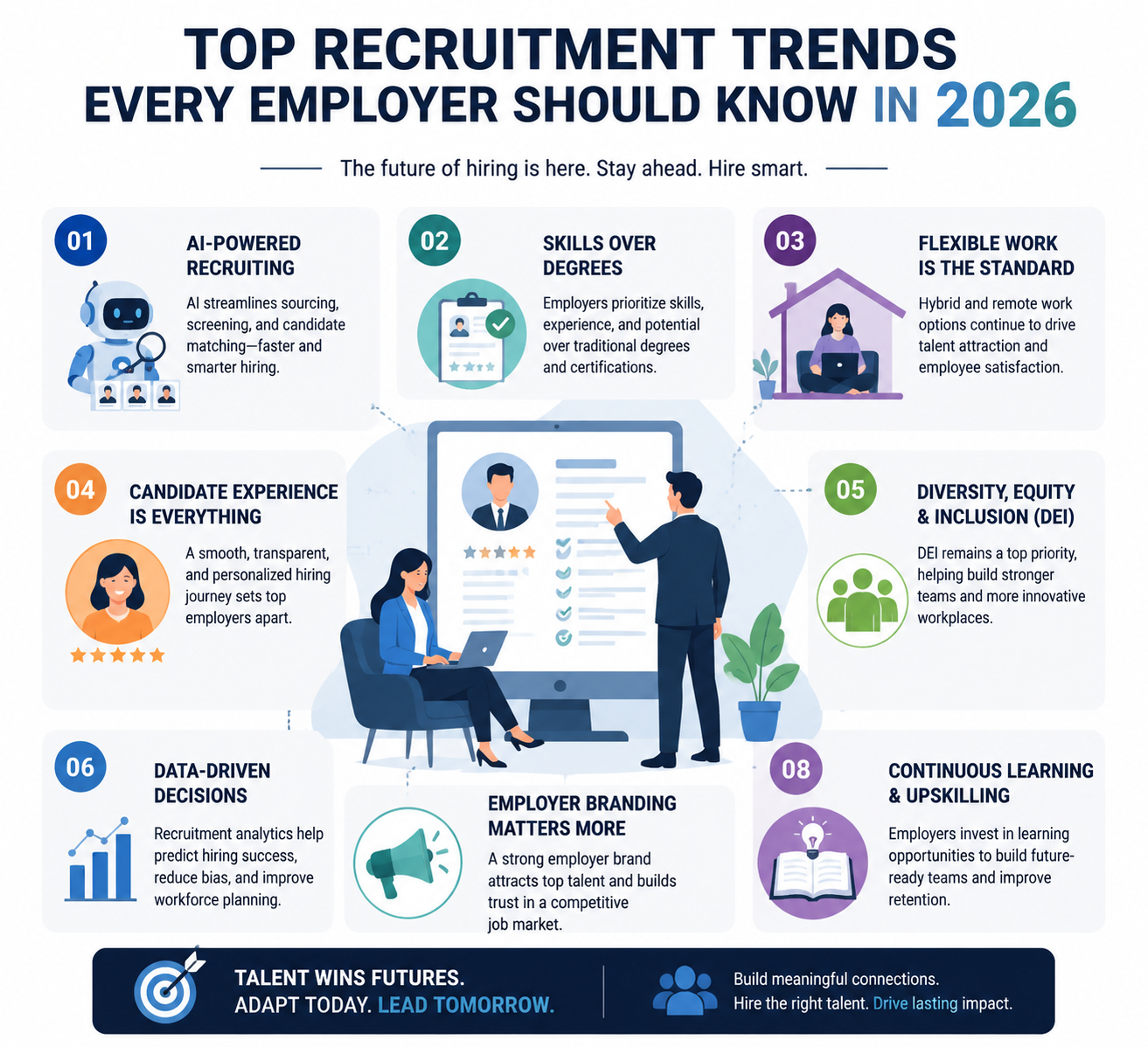
Artificial Intelligence is transforming recruitment by automating resume screening, candidate matching, interview scheduling, and predictive hiring analytics. AI helps recruiters focus more on strategic decision-making while reducing manual administrative tasks.
2. Skills-Based Hiring
Organizations are increasingly prioritizing practical skills and real-world experience over traditional degree requirements. Technical assessments, coding challenges, and portfolio evaluations are becoming standard hiring practices.
3. Remote and Hybrid Hiring
Remote work continues to expand access to global talent pools. Employers are hiring professionals across different regions while offering flexible work arrangements to improve employee satisfaction.
4. Employer Branding
Candidates actively research company culture, employee reviews, and workplace values before accepting job offers. Strong employer branding has become essential for attracting qualified professionals.
5. Data-Driven Recruitment
Recruitment teams are using analytics to measure hiring performance, identify bottlenecks, optimize sourcing channels, and improve overall recruitment effectiveness.
6. Employee Referral Programs
Employee referrals remain one of the most reliable sources of quality candidates. Many organizations are expanding referral programs to accelerate hiring while improving retention.
7. Diversity, Equity, and Inclusion (DEI)
Inclusive hiring practices continue to gain importance. Companies are implementing unbiased recruitment processes and expanding diversity initiatives to create stronger, more innovative teams.
8. Recruitment Automation
Automation tools streamline interview scheduling, candidate communication, onboarding, and document management, allowing recruiters to focus on relationship building.
9. Candidate Experience
Providing a positive application and interview experience has become a competitive advantage. Fast communication, transparent hiring processes, and personalized interactions improve employer reputation.
10. Continuous Talent Pipelines
Rather than hiring only when vacancies arise, organizations are building long-term talent pipelines by nurturing relationships with potential candidates.
How Employers Can Adapt
- Invest in AI-powered recruitment platforms.
- Focus on skills-based hiring rather than only academic qualifications.
- Strengthen employer branding across digital platforms.
- Offer flexible work arrangements.
- Improve candidate communication.
- Use recruitment analytics to optimize hiring.
- Build long-term talent communities.
- Implement structured interview processes.
- Promote diversity and inclusion initiatives.
- Partner with experienced recruitment agencies when needed.
Common Recruitment Challenges
- Talent shortages in specialized industries.
- Increasing competition for skilled professionals.
- Long hiring cycles.
- High recruitment costs.
- Employee retention challenges.
- Skills gap in emerging technologies.
- Managing remote recruitment processes.
Future of Recruitment
The future of recruitment will be driven by technology, automation, personalization, and data analytics. Organizations that combine advanced hiring tools with human-centric recruitment strategies will be better equipped to attract, engage, and retain top talent in an increasingly competitive market.
Conclusion
Recruitment is no longer just about filling vacancies—it's about building a sustainable workforce that supports long-term business growth. By embracing emerging recruitment trends such as AI, skills-based hiring, remote work, employer branding, and recruitment analytics, employers can create more effective hiring strategies and gain a competitive advantage in today's talent market.