Introduction
Businesses today require flexible technology solutions to manage changing project requirements, skill shortages, and digital transformation goals. Choosing the right engagement model plays an important role in controlling costs, improving productivity, and achieving business objectives.
Resource augmentation and managed services are two popular approaches that help organizations access external expertise. While both models provide technology support, they differ significantly in control, responsibility, management approach, and business outcomes.
What Is Resource Augmentation?
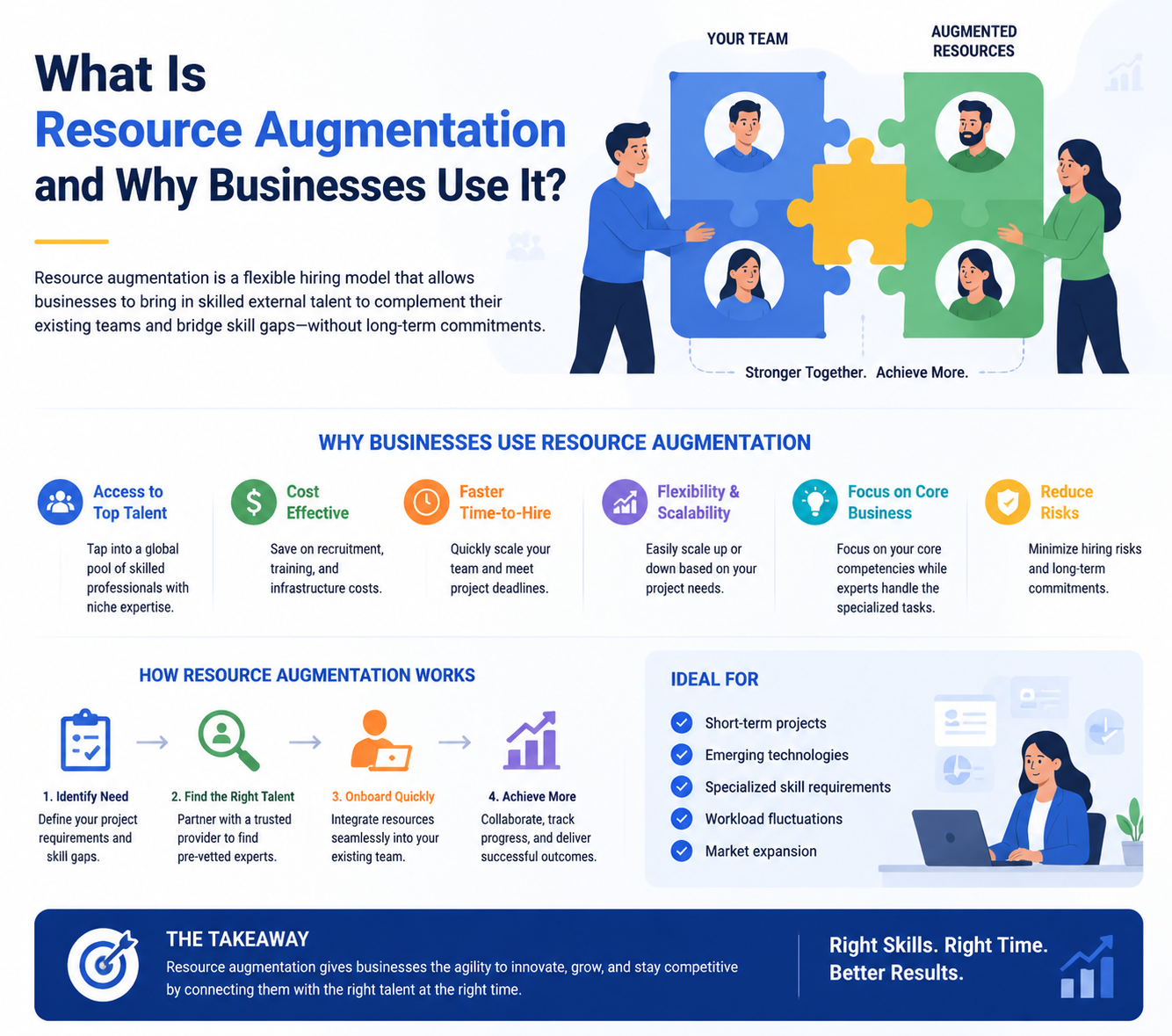
Resource augmentation is a hiring model where businesses add external professionals to their existing teams to fill skill gaps or increase development capacity. The external resources work under the company's direction and follow internal processes.
Companies commonly use resource augmentation to hire developers, designers, QA engineers, cloud specialists, project managers, and other technology experts for specific projects.
What Are Managed Services?
Managed services involve outsourcing the responsibility of managing specific IT functions or operations to an external service provider. The provider manages the processes, resources, performance, and outcomes based on agreed service levels.
Managed service providers commonly handle areas such as IT infrastructure, cybersecurity, cloud operations, application support, monitoring, and maintenance.
Key Differences Between Resource Augmentation and Managed Services
- Control: Resource augmentation allows businesses to directly manage external resources, while managed services providers manage the complete service delivery.
- Responsibility: Resource augmentation adds skilled professionals, while managed services transfer responsibility for specific operations.
- Management: Internal teams manage augmented resources, while service providers manage managed service teams.
- Flexibility: Resource augmentation offers flexible team scaling, while managed services provide ongoing operational support.
- Project Ownership: Companies maintain ownership with resource augmentation, while providers manage outcomes in managed services.
- Cost Structure: Resource augmentation is usually based on resources or hours, while managed services often use fixed service agreements.
Benefits of Resource Augmentation
- Quick access to skilled professionals.
- Greater control over development activities.
- Flexible team expansion.
- Reduced recruitment time.
- Lower hiring risks.
- Access to specialized expertise.
- Easy integration with existing teams.
- Ideal for project-based requirements.
Benefits of Managed Services
- Complete management of IT operations.
- Predictable costs through service agreements.
- 24/7 monitoring and support.
- Improved operational efficiency.
- Access to specialized service expertise.
- Reduced internal IT workload.
- Better system reliability.
- Improved security and compliance management.
When Should You Choose Resource Augmentation?
Resource augmentation is suitable when businesses need additional professionals but want to maintain complete control over project decisions, workflows, and development processes.
- Software development projects.
- Temporary skill shortages.
- Need for specialized developers.
- Startup product development.
- Digital transformation projects.
- Short-term technology requirements.
- Scaling internal engineering teams.
When Should You Choose Managed Services?
Managed services are suitable when companies want an external partner to take complete responsibility for managing specific IT functions and ensuring continuous performance.
- IT infrastructure management.
- Cloud operations.
- Cybersecurity monitoring.
- Application maintenance.
- Technical support services.
- Network management.
- Long-term IT operations.
Resource Augmentation vs Managed Services Comparison
- Management Control: Resource Augmentation - Client controlled | Managed Services - Provider controlled
- Team Ownership: Resource Augmentation - Client team extension | Managed Services - External service ownership
- Best For: Resource Augmentation - Projects and skill gaps | Managed Services - Ongoing operations
- Flexibility: Resource Augmentation - High flexibility | Managed Services - Structured service delivery
- Responsibility: Resource Augmentation - Client manages tasks | Managed Services - Provider manages outcomes
- Duration: Resource Augmentation - Short or long term | Managed Services - Usually long term
How to Choose the Right Model
- Define your business goals.
- Identify whether you need people or complete service management.
- Evaluate internal technical capabilities.
- Consider project duration.
- Analyze budget requirements.
- Determine required level of control.
- Review scalability needs.
- Choose an experienced technology partner.
Conclusion
Both resource augmentation and managed services provide valuable solutions for modern businesses. Resource augmentation is ideal for companies that need skilled professionals while maintaining project control. Managed services are better suited for organizations that want complete IT management and operational support. The right choice depends on business goals, technical requirements, budget, and desired level of involvement.