Introduction
Artificial Intelligence and Machine Learning are transforming industries by enabling automation, predictive analytics, intelligent applications, and data-driven decision-making. As businesses accelerate digital transformation, demand for skilled AI professionals continues to grow rapidly.
However, finding experienced AI and Machine Learning professionals has become a major challenge for organizations due to limited talent availability and increasing competition among employers.
Why AI Talent Is in High Demand
Organizations across industries are investing in AI technologies to improve efficiency, automate processes, enhance customer experiences, and create innovative products. This has increased demand for professionals who can design, develop, and deploy intelligent systems.
- Growing adoption of Generative AI.
- Increasing business automation requirements.
- Demand for predictive analytics.
- Expansion of AI-powered applications.
- Need for intelligent data processing.
- Growth of machine learning-based solutions.
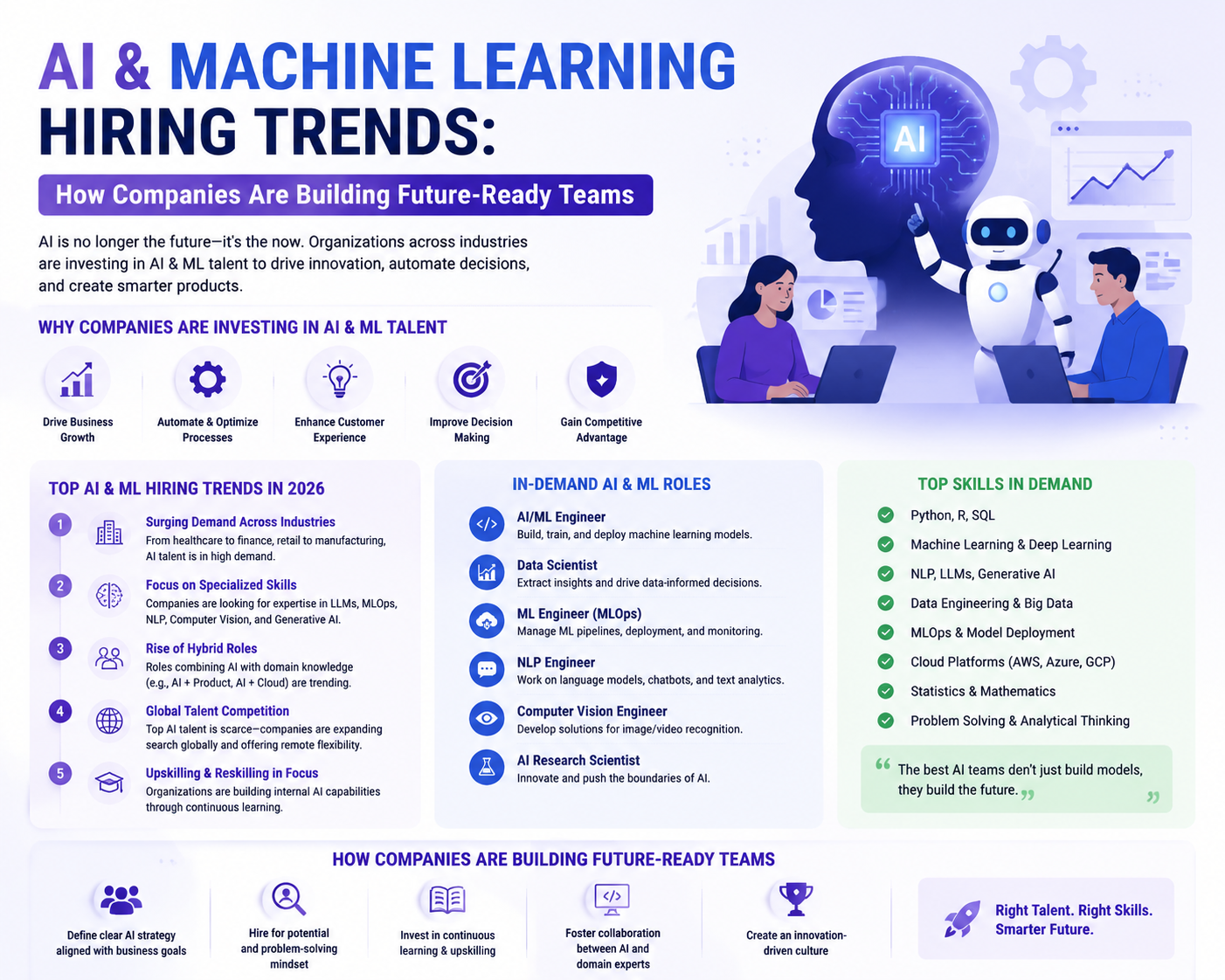
Current AI & Machine Learning Hiring Trends
1. Increased Demand for AI Engineers
Companies are actively hiring AI engineers who can build machine learning models, develop intelligent applications, and integrate AI solutions into existing business systems.
2. Growth of Generative AI Roles
Generative AI has created demand for professionals skilled in large language models, prompt engineering, AI automation, and AI application development.
3. Focus on Practical AI Experience
Employers are increasingly prioritizing candidates with real-world AI project experience rather than only academic qualifications.
4. Remote Hiring for AI Professionals
Companies are expanding their search globally by hiring remote AI specialists through flexible workforce models such as staff augmentation and dedicated development teams.
5. AI Combined With Industry Expertise
Organizations prefer AI professionals who understand both technology and business domains such as healthcare, finance, retail, and manufacturing.
Most In-Demand AI Skills
- Machine Learning Algorithms
- Deep Learning
- Neural Networks
- Natural Language Processing
- Computer Vision
- Generative AI
- Large Language Models (LLMs)
- Prompt Engineering
- Python Programming
- TensorFlow
- PyTorch
- Data Analytics
- MLOps
- Cloud AI Platforms
Roles Companies Are Hiring For
- AI Engineer
- Machine Learning Engineer
- Data Scientist
- Data Engineer
- Deep Learning Engineer
- NLP Engineer
- Computer Vision Engineer
- AI Product Manager
- MLOps Engineer
- AI Research Scientist
Challenges in Hiring AI Professionals
- Shortage of experienced AI specialists.
- High competition among companies.
- Rapid changes in AI technologies.
- Difficulty evaluating AI expertise.
- High salary expectations.
- Limited availability of senior AI professionals.
- Long recruitment cycles.
How Companies Can Attract AI Talent
- Offer competitive compensation packages.
- Provide opportunities to work on innovative projects.
- Support remote and flexible work options.
- Build strong employer branding.
- Create AI-focused career growth opportunities.
- Partner with specialized technology recruiters.
- Use global talent acquisition strategies.
AI Hiring Through Staff Augmentation
AI staff augmentation helps businesses quickly access experienced AI professionals without lengthy recruitment processes. Companies can hire machine learning engineers, data scientists, and AI developers for specific projects while maintaining flexibility and cost control.
- Faster access to AI specialists.
- Reduced recruitment costs.
- Flexible team expansion.
- Access to global AI talent.
- Lower long-term hiring risks.
- Ability to scale AI projects quickly.
Future of AI Recruitment
The demand for AI professionals will continue growing as businesses integrate intelligent technologies into their operations. Future recruitment strategies will focus on specialized skills, practical experience, continuous learning, and flexible hiring models.
Conclusion
AI and Machine Learning are reshaping the future of technology and business. Organizations that successfully attract and retain AI talent will gain a significant competitive advantage. By adopting modern hiring strategies, leveraging staff augmentation, and focusing on specialized skills, companies can build powerful AI teams ready for future innovation.